Since 1999, now US-based—wildlife conservation. Flowers & insects first: then science-backed nectar.

INGREDIENTS & USE
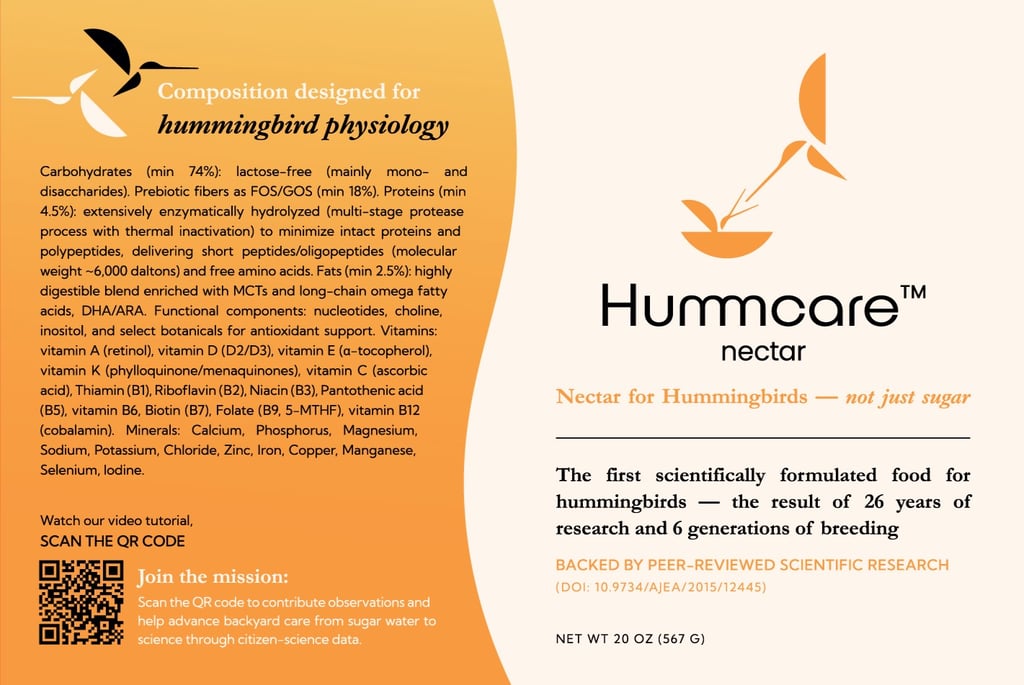
Hummcare Nectar: the World’s First Scientifically Formulated Nectar.
The result of 26 years of research and 6 generations of breeding. Finally, a complete diet designed for their physiology—not just sugar water.
A diet of sugar and water alone leads to malnutrition.
Warning: never abruptly remove a feeder that birds already rely on. Taking away an established food source, without plenty of natural native flowers, can condemn them to death.
Mixing guide
Hummingbirds often choose what’s sweet over what’s nutrient-dense. Some will prefer plain sugar water at first.
Option A — Pure (most nutritious)
Use 1 scoop (≈15 g) / 100 ml water (minimum)
Up to 2 scoops / 100 ml water (maximum)
Option B — Sweet-adaptation mix (1:1)
1 scoop Hummcare Nectar + 1 scoop white sugar, then mix into 100 ml water
This halves the nutrient concentration in the dry blend (protein ~2.3%, fats ~1.3%), yet it remains a true nectar with essential nutrients—not comparable to sugar-only water.
Safety: Your pouch contains one or two silica packets—discard the silica packets.
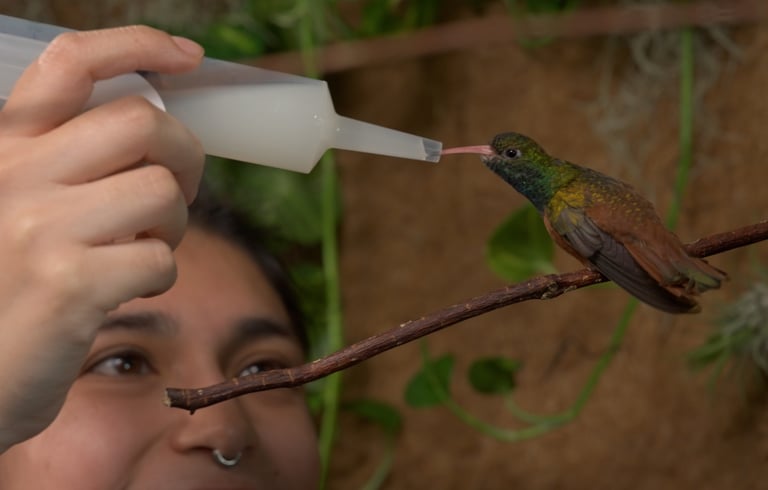
For nestlings (veterinarians & rehabilitation centers only):
Give from day 0 with live insects (essential mainly for gut motility and aerobic/anaerobic microbiota, not just protein).
If insects are abundant (e.g., Drosophila), no extra protein is needed. If insects are limited, add 3–6% highly hydrolyzed protein (dry-matter basis) or contact us for our amino acid & peptone mix.
Is Sugar Water Enough?
Sugar water provides energy, but hummingbirds cannot live on sugar alone.
Grounded in 26 years of research and documented in scientific literature, our DOI-validated formula is a complete nectar created to meet real hummingbird nutritional needs beyond empty calories.
Even abandoned nestlings have been successfully raised on this formula from hatch to flight.
Field-tested
Produced by our scientific institution in our laboratories, building on research conducted in cooperation with Chelab Laboratories (Treviso, Italy), Seris Lab (Genova, Italy), and the Department of Agricultural and Environmental Science, University of Udine, Italy.
Field-tested in Ecuador, Colombia, Peru, Dominican Republic and in European Zoological Institutions.
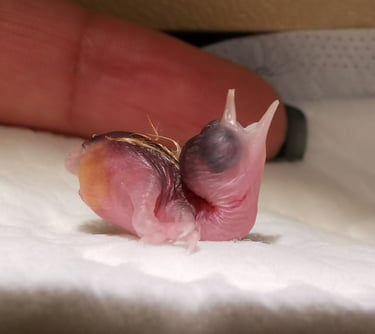
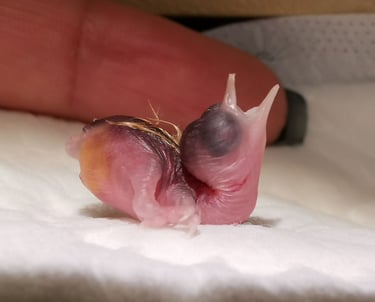
From hatching
Our Nectar has allowed the weaning of hummingbird nestlings abandoned by their mothers on the first day of life
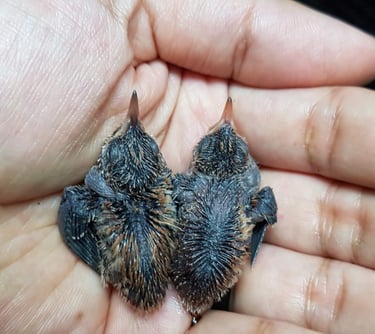
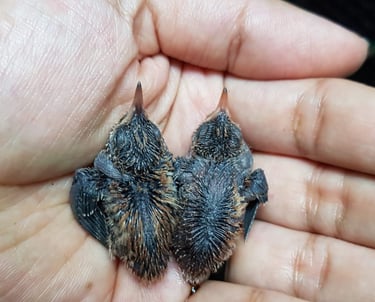
To fledging
Our nectar has allowed the complete development of the little hummingbirds weaned by our keepers
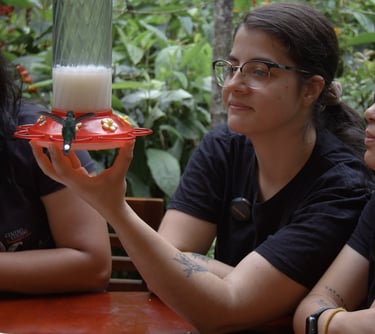
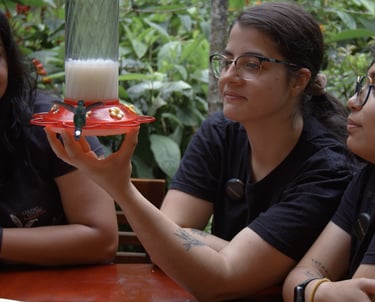
Ecuadorian research station
in the Ecuadorian scientific station with our: Vice Director Federica Cardarelli, Senior Keeper Thalia Pardo and assistant Jane Villasis
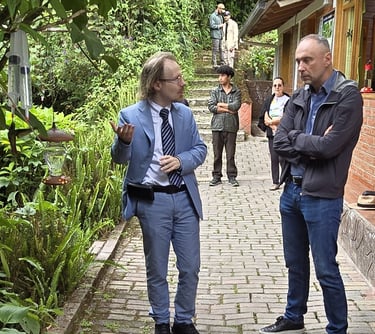
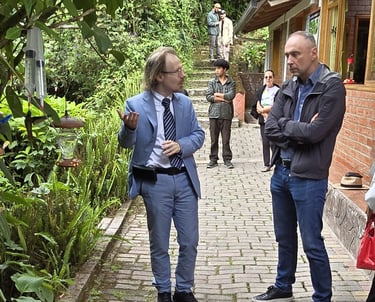
His Excellency
Our nectar inaugurated by His Excellency the Ambassador of Italy in the Ecuadorian cloud forest
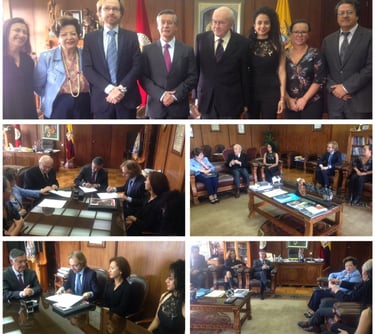
The Ecuadorian University
The agreement with the Universidad UCE, in the presence of Rector Fernando Sempértegui and Dean of Veterinary Medicine Prof. Aragon
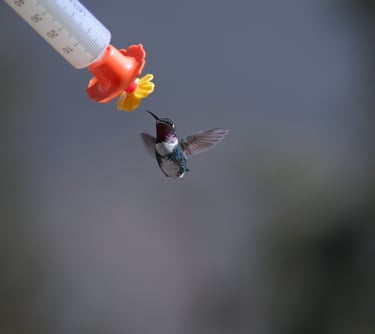
Also in Colombia and Peru
Our nectar is also used in Colombia and Peru to detoxify hummingbirds accustomed to water and sugar


Italian Deputy Minister Dr. Menia in Peru
The two Ministries of the Environment join forces to produce Hummcare Nectar in Peru
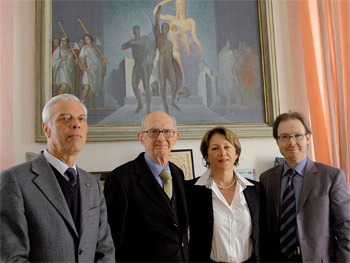
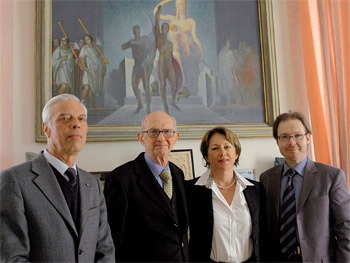
The University of Udine
Rector Prof. Compagno, Prof. Susmel, and the late Prof. De Ferra back in 2008 during the study of the first formulations of the nectar
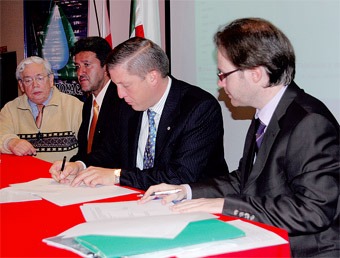
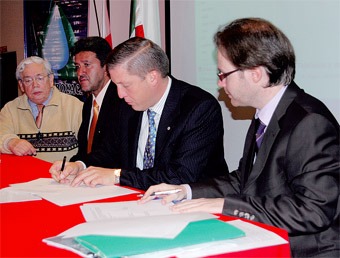
The Colombian University
The agreement with the University of Boyaca in with the envoy of the President of the Republic of Colombia, Hon. Ciro Montañez


Italy 1999, where it all began...
Prof. Karl Schuchmann (University of Bonn) who first decoded hummingbirds’ diet in 1978. The godfather who helped found our Center!
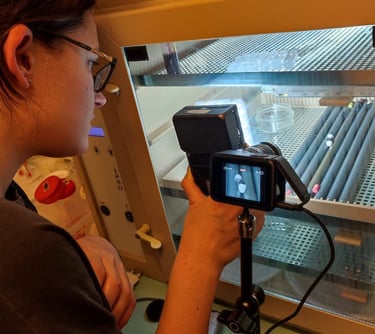
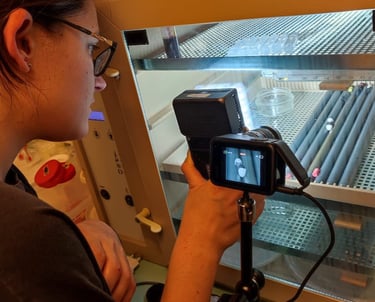
The incubator
Our Curator Rebeca Guler monitoring the temperature, humidity, and heartbeat of the embryo
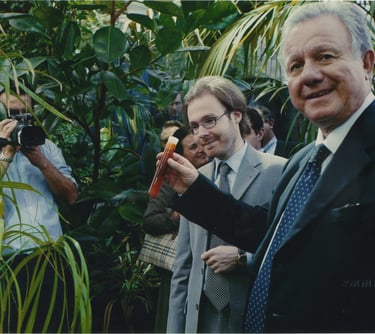
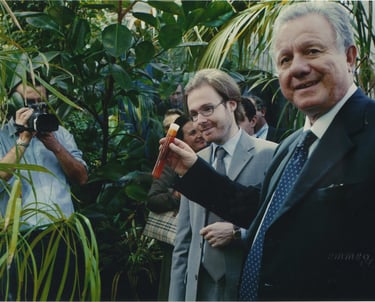
The Minister of the Environment
Back in 2004, the Italian Minister of the Environment inaugurated the first experimental version of Hummcare Nectar
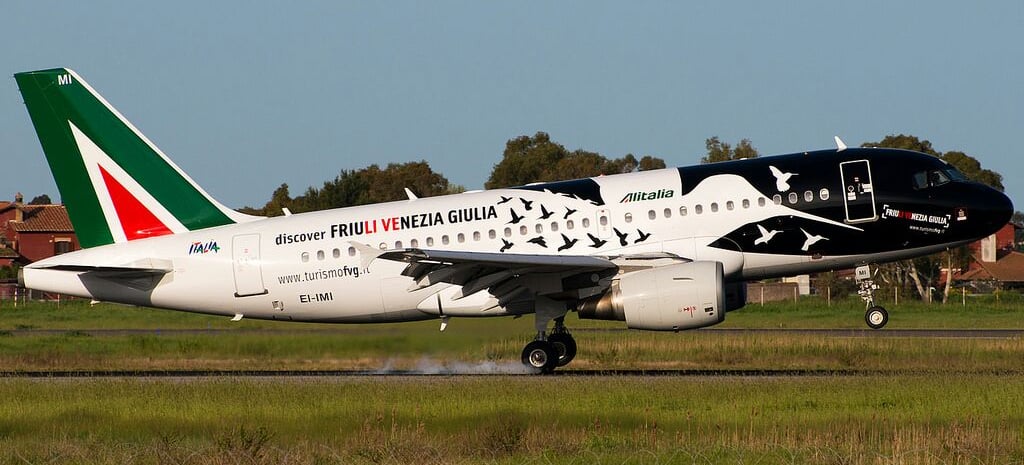
A Tribute to Our Origins
Alitalia and Italy’s Friuli Venezia Giulia regional government dedicated this livery to our Center’s work, with the hummingbird as its emblem—a tribute to our research since 1999. A high-flying symbol of conservation that took off in Italy and has now landed in the United States.
Hummingbirds Center Research Institute - Centro Colibri, Inc.
Nonprofit research institute 501(c)(3)
447 Broadway, 2ND FL 1012
New York, NY 10013,
United States